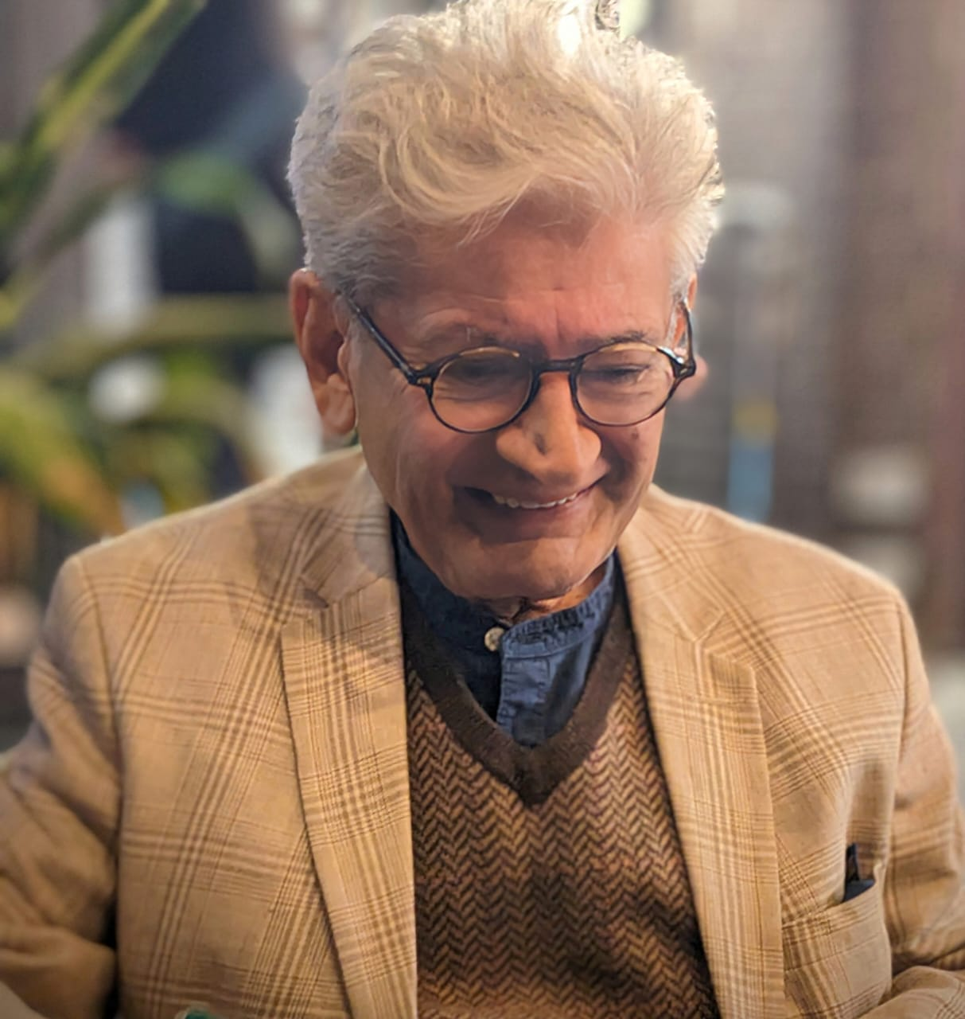
Akbar Noman -Midnight’s Child, effortless embodiment of ‘Tehzeeb’ (i.e. etiquette/refinement/culture), beloved teacher, mentor and loving friend, passed away peacefully at Oxford last night.
He was the spirit and promise of an age. Born in Hyderabad, India, in 1947, in the last days of the princely state, he came into the world at a moment when an old order was disappearing and a new one was being born. His father was the Nizam’s Information Minister, and once the state was incorporated into the country, he grew up in the broad tradition of an educated, public-spirited bureaucratic elite— that very fine slice of people who genuinely believed that a life could be devoted to institutions, ideas, and the larger public good.
In the 1950s, the family moved to Pakistan, less as Akbar would say because of any worries about religion, as much as for the career advancement of his father. He grew up at time when there was less enmity between India and Pakistan; he would regularly visit his friends and parents in India on the overnight ship that plied between Karachi and Bombay, and never felt anything but Indian; and, he would have been at pains to point out, an Indian from the South. He remained a lifelong admirer of Jawaharlal Nehru.
He grew up in a different Pakistan than now, in his milieu at least, one that was more liberal; and one that was inevitably careening towards self destruction. He was also of a generation and class that could think of Oxford and Cambridge as natural places to get a higher education (he was at Oxford). He was ecumenical, having friends from different backgrounds and political predilections, but over his entire life, he never wavered on a strong secularism- and his sorrow over its degradation was genuine and deepfelt.
Over the years, he became a seasoned diplomat moving comfortably among governments, financial institutions, economists and statesmen, and acquiring the kind of international experience that very few people ever do. In one of his characteristically astute recollections, he noted how, on one trip back to Pakistan, alcohol had suddenly been banned from the airport. When he asked why and how he could get a drink, the waiter apparently just said “Woh toh bade log ke liye hai” (that is only for ‘big people’). He remembered it as the curdling of some promised future, the return of a cynicism and naked abuse of power and privilege , and the descent into the darkness of religious bigotry that engulfed the subcontinent over the next 50 years.
Despite this and despite the constant fraying of the promise of post-independence South Asia through the 1970s he remained a man of the idealistic generation in which he had grown up: convinced that public life mattered, that developing countries could change their fortunes, and that serious people could make a difference.
His intellectual and professional life was no less remarkable. He had a long career at the World Bank, and towards the end of his time there, played an important role in dissemination and popularization of the World Bank’s great work on the East Asian economic miracle—the World Development Report and became very closely involved with Joe Stiglitz after that. He became central to the intellectual activities of the Initiative for Policy Dialogue (IPD), set up in 2000. At IPD, he led several Africa Task forces, given his long standing interest in the development of the continent and was still an IPD senior fellow when he passed.
He was also the key architect and patron saint of the Advanced Graduate Workshop for Development (AGW) that IPD ran for nearly two decades-first in Manchester and then in Bangalore. Akbar loved students deeply and was particularly keen to support them in periods of a lack of self-confidence, to insist that workshops were not places to be gladiatorial, but to generate a spirit of collective learning. The AGW was really the Akbar Graduate Workshop and students became lifelong admirers and friends, even as they became well known economists, politicians and social scientists themselves. He would listen to every student presentation, make very astute and considered remarks, and leave students feeling more confident and edified at the end. At the end of every workshop, he would make the best impromptu speeches, remembering each and every student’s particular strength and foibles (rendered in a gentle way) and the staff who inevitably were willing to do everything for him.
Per Kipling’s dictum, he walked with kings (and presidents and prime ministers) but somehow, wonderfully, he never lost the common touch. He could move effortlessly from the corridors of power to an entirely ordinary conversation, and he treated both with the same warmth and curiosity. And also, at points displayed a wicked and unexpected humour and wit.
He lived in Hyderabad, Karachi, Baku, Oxford, Addis Ababa, New York, and many other places besides. He belonged, in some strange way, to all of them and to none. His life was also beset by tragedy, with his beloved son Zafar passing away at age 25 of an aggressive cancer. Despite these deep personal sorrows, he was always gracious about his blessings and always warm with his immediate and extended family. He found love wherever he went. The last part of his amazing life was spent battling Parkinson’s and the indignities it brought. But he passed away in his beloved Oxford surrounded by people who loved him.
He had friends and well-wishers all over the world, and today, they are all experiencing a broken feeling. It is so rare today to find people who deeply and with dignity and belief, strive for a more just and kind world, and who make you feel cared for, regardless of your background and past. Akbar was one of the last of that special generation of people who could do so effortlessly.
We will miss him terribly.
Thank you for everything, always,
Alvida Akbar Saheb

 Jenny Ricks